
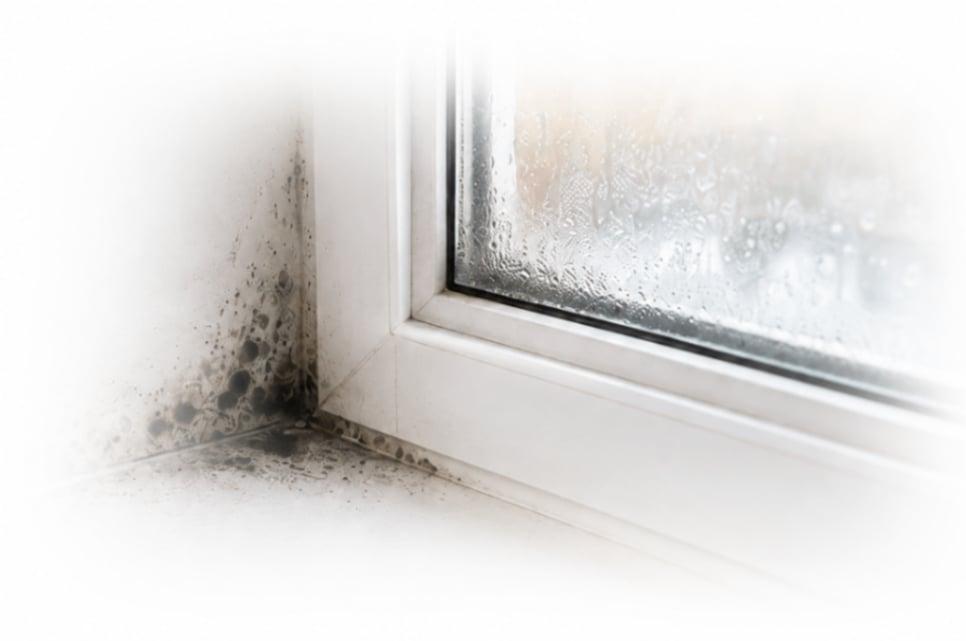
Condensation and Mould: Why Opening a Window Isn't Always the Answer
Condensation and mould are among the most common issues encountered during residential property inspections. They are frequently attributed to inadequate ventilation, with recommendations to open windows, increase heating or improve air circulation.
Whilst these measures may help in certain circumstances, condensation is rarely explained by ventilation alone. Surface temperatures, relative humidity, insulation, thermal bridging and building construction all influence where and why moisture accumulates.
For residential surveyors, understanding these relationships is essential to identifying potential contributing factors and providing accurate, proportionate advice.
Understanding why condensation occurs
Condensation forms when moisture-laden air comes into contact with a surface at or below its dew point temperature.
For example, indoor air at 20°C and 60% relative humidity has a dew point of approximately 12°C. If a wall or window surface falls below this temperature, condensation may form.
However, visible condensation is not necessary for mould growth. Mould can develop where the relative humidity immediately adjacent to a surface remains sufficiently high for prolonged periods, even if the surface does not reach the dew point.
This distinction is important because a wall may appear dry whilst still providing conditions suitable for mould growth.
Thermal bridging: the overlooked factor
Thermal bridging occurs where heat flows more readily through a particular part of the building fabric due to a material with higher thermal conductivity, reduced insulation or a discontinuity in the insulation layer. This creates a localised area of increased heat loss and lower internal surface temperatures, increasing the risk of surface condensation and mould growth where humidity levels are sufficiently high.
Common examples include window reveals, external wall corners, concrete lintels and junctions between walls and floors.
For example, mould concentrated around a window reveal, whilst the surrounding wall remains unaffected, may indicate a localised cold surface associated with thermal bridging.
During inspections, surveyors should consider whether the mould pattern corresponds with likely thermal bridges, particularly where insulation has been installed or windows have been replaced.
Thermal imaging can sometimes help identify temperature differences, but results must be interpreted carefully. Thermal images show surface temperature patterns rather than directly identifying moisture or insulation defects, and their usefulness depends on suitable environmental conditions.
Simply advising occupants to open windows may not adequately address the underlying problem where low surface temperatures are a significant contributing factor.
Why replacement windows can change the problem
Modern double glazing generally improves thermal performance and reduces unwanted air leakage.
However, replacing older windows with more airtight units can also reduce incidental ventilation, particularly in properties without an adequate alternative ventilation strategy.
Moisture generated through cooking, bathing, drying clothes and everyday occupation may then accumulate indoors.
Interestingly, condensation may no longer appear on the glazing because the internal glass surface is warmer. Instead, moisture may accumulate on colder walls, corners and window reveals.
When inspecting properties with replacement windows, surveyors should consider the presence and condition of background ventilators, extract ventilation in kitchens and bathrooms, and any evidence of persistent condensation or mould.
Where mould has reportedly developed following window replacement, the timing may provide useful context, although it does not establish that the replacement windows are the cause.
Is it condensation or penetrating damp?
Not all staining or mould around windows is caused by condensation.
Defective external sealants, deteriorated pointing, inadequate sill detailing and water penetration around window frames can produce similar symptoms.
The location and pattern of moisture can provide useful clues. Mould concentrated on colder surfaces and external corners may suggest surface condensation, whilst localised staining associated with defective external detailing may indicate rainwater penetration.
However, these patterns are not conclusive, and more than one moisture source may be present.
Surveyors should examine accessible external areas, including window surrounds, pointing, sills and rainwater goods, whilst considering the property's exposure and construction.
Moisture meter readings can assist with identifying variations in moisture conditions, but electrical resistance readings on masonry and plaster can be influenced by salts and other materials. They should not be relied upon in isolation to establish the source of moisture.
Five practical checks during a residential inspection
When investigating condensation and mould, surveyors should consider the following:
1. Assess the distribution of mould. Is it concentrated around window reveals, external corners, behind furniture or across several rooms? The pattern may help identify possible cold surfaces, restricted air circulation or wider humidity issues.
2. Consider ventilation provision and condition. Look for background ventilators, mechanical extract fans and signs of inadequate ventilation. Note that a fan being present does not necessarily mean it is operating effectively, and a visual survey will not normally establish its extraction performance.
3. Review alterations to the building. Replacement windows, internal insulation, loft insulation and changes to heating arrangements may affect surface temperatures, airtightness and moisture movement.
4. Look for alternative moisture sources. Consider defects to external walls, window seals, rainwater goods and plumbing installations. Avoid attributing all staining or mould to occupant behaviour without examining the building fabric.
5. Record the evidence and limitations. Note the location, extent and characteristics of affected areas, relevant surrounding conditions and any inspection restrictions. Temperature and humidity readings may provide useful context, but a single measurement represents conditions at that particular time and may not reflect longer-term patterns.
Where the cause remains uncertain, further investigation may be appropriate, particularly where mould is extensive, persistent or associated with suspected concealed moisture problems. Recommendations should be proportionate to the observed evidence and the limitations of the inspection.
From inspection findings to intelligent reporting
Accurately recording inspection findings is only part of the process. Surveyors must then bring together observations, photographs, voice recordings and professional knowledge to produce clear, technically appropriate and property-specific commentary.
This is where MyReport® and its AI-powered reporting assistant, Report Genius®, can make a real difference.
Developed specifically for professional surveyors, Report Genius® works with the surveyor's own inspection notes, voice recordings, existing report content and personalised reporting knowledge to help generate structured commentary that reflects their preferred writing style and professional approach.
For example, where mould is observed around a window reveal, alongside findings relating to thermal bridging, ventilation and possible moisture penetration, Report Genius® can organise these observations, allocate information to the relevant report sections and assist with preparing detailed, property-specific commentary.
Unlike generic AI writing tools, Report Genius® can learn from the surveyor's own reporting knowledge and preferred terminology, helping maintain consistency while reducing repetitive drafting and saving valuable time.
Importantly, the surveyor retains full control over the final commentary and professional recommendations. AI assistance is entirely optional, and MyReport® remains a comprehensive reporting platform even when AI is switched off.
Ultimately, Report Genius® is designed to support professional expertise, not replace it, helping surveyors turn their inspection findings and knowledge into high-quality reports more efficiently.
Final thoughts
Condensation and mould are not always simply the result of occupants failing to open windows.
They arise from the interaction between moisture production, ventilation, heating, surface temperatures and building construction. Defects in the building fabric may also contribute.
For residential surveyors, the challenge is to distinguish between possible causes, recognise the limitations of a visual inspection and provide advice supported by the available evidence.
Opening a window may help, but understanding why mould has developed is the more important starting point.